The Artist's Perspective | Historical & Technical Context
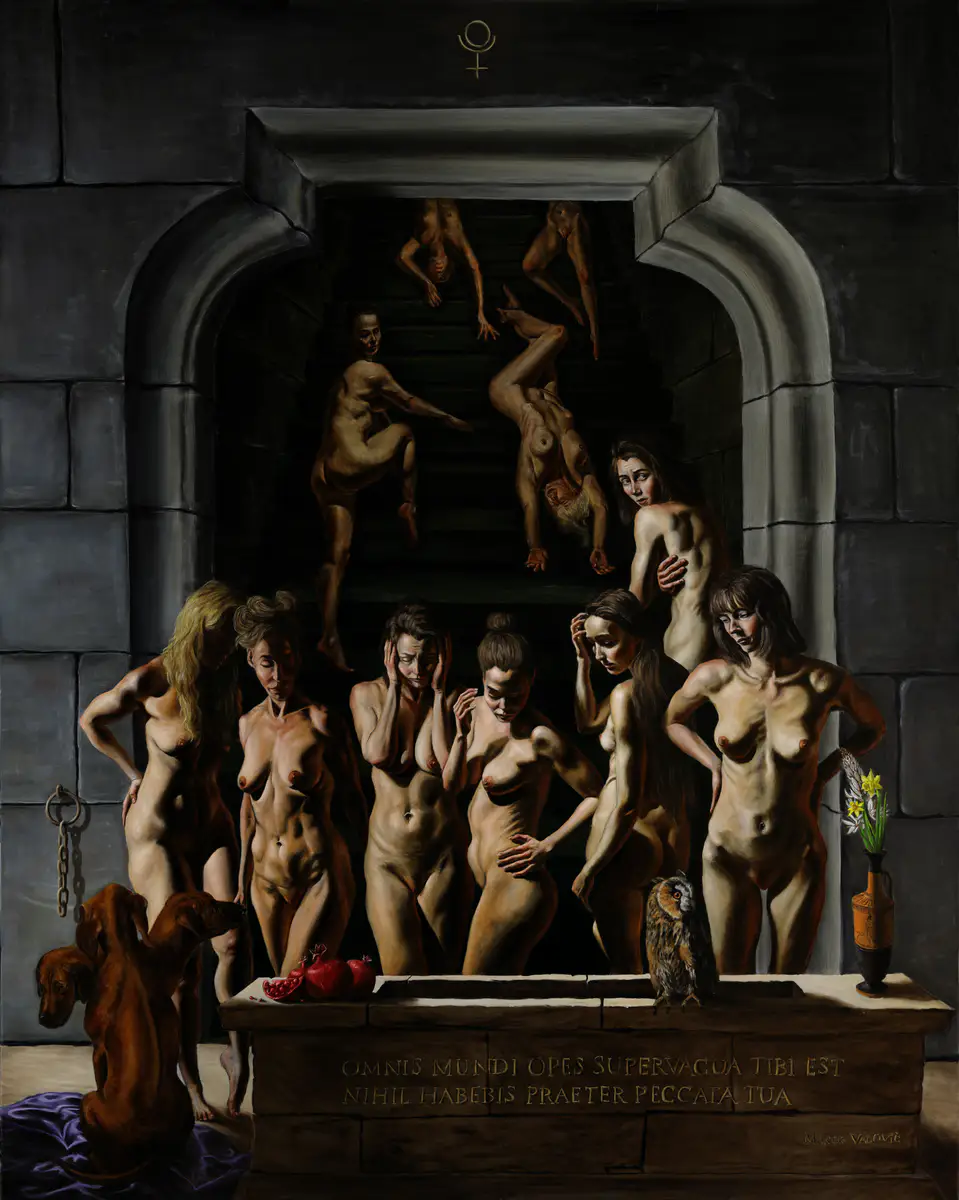
We spend our light trying to escape the dark, only to find that the darkness was the only thing that never lied to us. In the end, you will possess nothing but the silence you earned. This 200x160cm canvas is a descent into Tartarus—the abyssal prison located beneath the underworld itself. To capture the suffocating atmosphere of this place, I utilized SiO2 (Silicon Dioxide) in my sun-thickened linseed oil. This mineral additive creates a unique refractive index, giving the paint a 'stone-like' quality that resonates with the cold walls of the abyss.
The composition of 11 figures explores the hierarchy of despair. While some attempt a futile ascent, others are drawn toward the central 'well'—the gateway to a darkness even deeper than death. The contrast between the organic flesh of the nudes and the inorganic, mineral textures created by the SiO2 mediums emphasizes the transition from the animated world of the living to the eternal stillness of the stone.
Symbols of the Underworld
The Sigil of Pluto:
Carved above the gates of the Underworld, this ancient symbol—a circle poised over a cross—represents the triumph of the spirit over matter. It marks the threshold of the subterranean realm, where the wealth of the earth and the finality of the soul intersect under the absolute reign of Hades.
The Royal Purple Cloak:
In ancient times, Tyrian purple was the most expensive pigment, reserved for emperors. Here, Cerberus rests upon it, signaling that even the terrifying guardian serves the sovereign majesty of Hades.
·
The Owl of Hades:
Not just a bird of night, but a silent witness to the secrets of the dead. The owl represents the cold, piercing wisdom that sees through the illusions of the living.
Cerberus, the Three-Headed Sentinel:
The formidable guardian of the Underworld gates, depicted here in a rare moment of stillness. His three heads represent the past, present, and future, all equally blind to those seeking to escape the inevitability of death.
·
The Funeral Lekythos:
An ancient Greek vessel containing the Asphodel (flower of the dead) and the Narcissus (flower of Hades’ entrapment of Persephone).
The Pomegranate (The Fruit of Entrapment):
A symbol of the unbreakable bond between the world of the living and the dead. Having been tasted by Persephone, its seeds represent her eternal tether to Hades. Here, it is presented as a gesture of dark affection—a reminder of the queen who shares the throne of the abyss.
The Well of Tartarus and the Eternal Inscription:
At the lowest point of the Underworld, a cold, stone-hewn well marks the entrance to a darker void—the Abyss of Tartarus. Carved into its ancient rim is the chilling mandate: "OMNIS MUNDI OPES SUPERVACUA TIBI EST. NIHIL HABEBITIS PRAETER PECCATA TUA" (All the world's wealth is useless to you. You shall possess nothing but your sins). From this lightless pit, the distorted, haunting faces of the damned peer out, their hollow gazes fixed upward in eternal longing. It is the ultimate finality of the soul’s descent, a place where even the mercy of forgetfulness is denied, and one’s own transgressions are the only remaining inheritance.