The Artist's Perspective | Technical & Symbolic Context
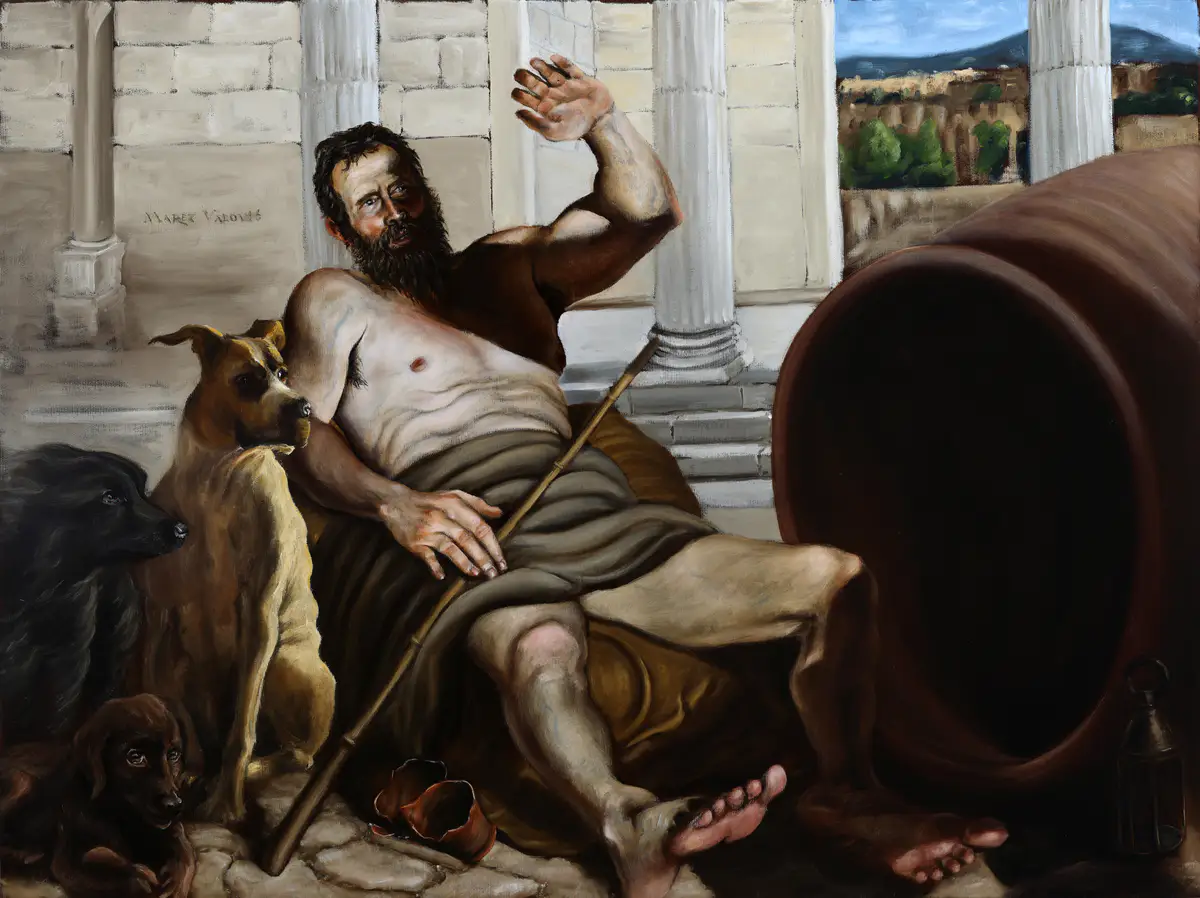
Seek not for flaws in the paint until you have faced the shadows in your own heart. Art demands the same uncompromising honesty from the viewer that it took from the creator. Technically, this work was an experiment in optical mixing. Unlike my usual systematic glazing, I mixed many of the mid-tones directly on the canvas, allowing the wet oil to create transitions that mimic the natural haze of a Mediterranean afternoon. This 'directness' mirrors Diogenes' own bluntness.
The narrative captures the legendary encounter where the world's most powerful man, Alexander, asks the world's poorest man what he can do for him. Diogenes' reply—'Stand out of my sun'—is visualized through the long, intrusive shadow cast across his reclining body. The broken jug on the ground serves as a silent testament to the moment Diogenes realized that even a cup is a luxury he no longer requires. By placing him among three dogs, I pay homage to the very root of the word 'Cynic' (Kynikos - dog-like), celebrating a life lived in raw harmony with nature, unshadowed by the ambitions of kings.
Symbols:
The Pithos (The Clay Home):
Correcting the historical anachronism of the wooden barrel—which did not appear in the Mediterranean for several more centuries—my Diogenes dwells in a Pithos. This large, weathered clay storage jar is a discarded vessel of commerce transformed into a sanctuary. It represents the ultimate boundary between the human soul and the external world, symbolizing that a true home is found in one's own mind, not in material possessions.
The Shadow (Intrusive Power):
The looming silhouette of Alexander the Great. It is not just a physical absence of light, but a symbol of worldly ambition and political power attempting to obscure the sun of Truth. The shadow represents the only thing a King can take from a Philosopher, yet it is also the only thing the Philosopher asks to have returned.
The Three Dogs (Symbols of Cynicism):
These loyal companions represent the "Cynic" (Kynikos – dog-like) way of life. One dog watches, one rests, and one remains alert, symbolizing the virtues Diogenes admired: honesty, lack of shame, and the instinctive ability to distinguish a true friend from a foe.
The Broken Jug (Final Renunciation of Needs):
A poignant symbol of Diogenes’ ultimate detachment. Upon seeing a child drink from his hands, the philosopher shattered his only vessel, realizing that even a cup was a superfluous luxury. It represents the liberation found in total simplicity.
The Tenebrist Illumination (The Interior Sun):
While Alexander’s shadow falls over the scene, the light hitting Diogenes’ weathered skin and beard (studied with anatomical precision) originates from an unseen source. It suggests an internal, spiritual enlightenment that no earthly conqueror can provide.